 CANADA
 USA
USA
 AUSTRALIA
 UK
UK

The AI Accounting Trap: Why Smart Australian CPA Firms Are Outsourcing (Not Just Automating) in 2026
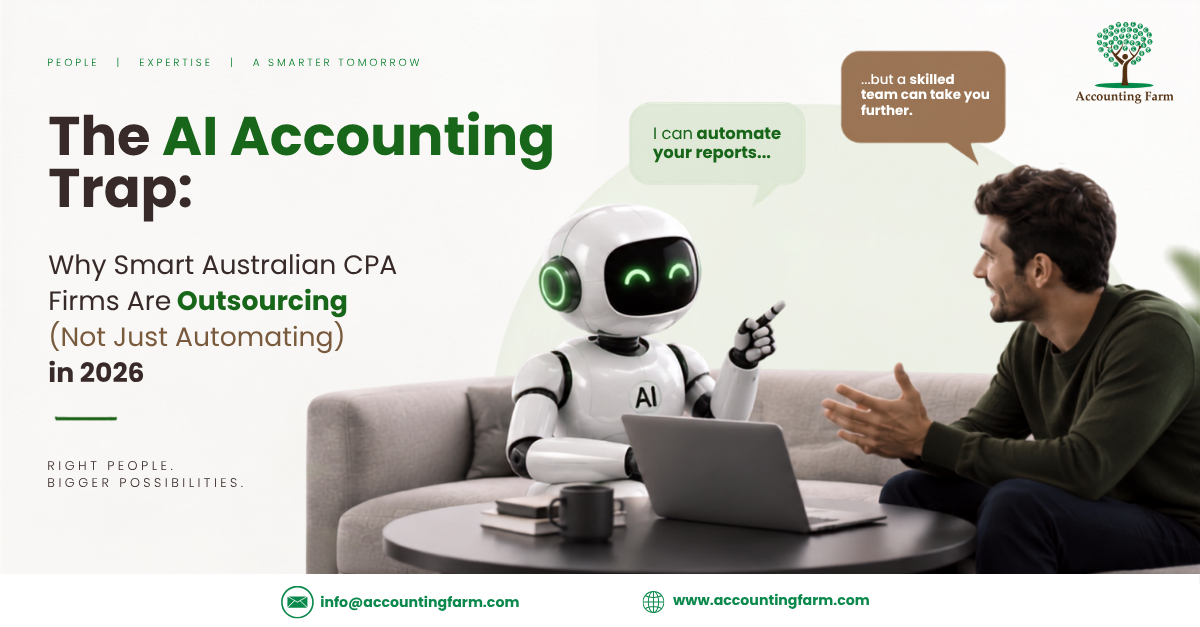
Quick response: The introduction of AI has meant less recruitment for junior accountants in Australia in the current year, at a time when there is more to be automated. Firms that treat AI as a replacement for staff are seeing review errors and compliance exposure rise. The firms pulling ahead in 2026 are pairing AI tools with outsourced accounting teams trained human reviewers who catch what automation misses, without the cost or delay of local hiring.
What Is the AI Accounting Trap in 2026?
The AI accounting trap is what happens when a firm uses artificial intelligence as a substitute for staff rather than as a tool alongside them. It looks efficient at first invoices to get categorised, reconciliations run overnight; draft reports appear in minutes. But nobody juniors are doing the underlying work anymore, which means nobody juniors are learning it either.
The result shows up later: senior partners end up re-checking AI output that “looked fine at first pass,” review queues grow, and the firm’s actual capacity doesn’t grow with its client list it shrinks under review load.
Why Is Junior Hiring Falling at Australian Accounting Firms?
The recruitment of both entry-level and graduate positions in the Australian accounting firms has been declining steadily until 2026 due to the reliance on automation in carrying out tasks that would train accountants. The number of local students taking the CPA exam has been declining every year while professionals are retiring.
That combination is a structural problem, not a temporary one:
- Fewer graduates entering the pipeline
- Automation absorbing the exact tasks juniors used to learn from
- Senior staff left to catch errors AI doesn’t flag on its own
- Rising recruitment costs for the experienced talent that remains
- What is Shadow AI and What is its Relevance to the CPA Firms?
The shadow AI is the use of artificial intelligence technology by the employees of the company without prior assessment, evaluation, and security from the leadership of the company due to short timeframes. The risk isn’t the AI itself. It’s client tax and financial data being pasted into a tool with no data agreement, no audit trail, and no accountability if something leaks.
According to the Privacy Act 1988, such liability lies on the side of the company rather than the employee who was forced to complete their work on time. The company may have an official AI policy in writing, but they will remain liable if there is no other way for the staff to go in case of high workload.
Outsourcing versus Automation: What Is the Real Difference?
These terms tackle different issues, and here comes the confusion.
- Automation (AI tools) Outsourced accounting
- What it replaces Repetitive manual data entry Hiring and training local junior staff
- Who reviews the output Whoever is left in-house A dedicated, trained offshore team
- Builds staff judgement No Yes via structured review workflows
- Scales with client growth Only if reviewed properly Yes, on demand
- Data handling Depends entirely on the tool used Governed by contract, NDA, and access controls
Automation removes keystrokes. Outsourcing adds trained capacity. Firms that use both, deliberately, avoid the trap firms relying on automation alone are falling into.
How Does Outsourcing Solve the AI Trap?
An outsourced accounting team gives a CPA firm a layer of trained human reviewers sitting between AI produced this, and a partner must fix this. Instead of automation output going straight to a stretched-thin senior team, it goes through people whose full-time job is exactly that review bookkeeping reconciliation, BAS preparation, payroll checks, and draft financial reporting.
That structure does three things at once:
- Protects review quality errors get caught before they reach the client, not after
- Protects senior time partners spend hours on advisory and client relationships, not re-checking line items
- Protects the pipeline a firm isn’t betting its future capacity entirely on software that can’t yet exercise professional judgement
- What Accounting Tasks Can Australian CPA Firms Safely Outsource?
A few of the tasks commonly outsourced to the outsourcing team include:
- Bookkeeping and banking reconciliations
- BAS preparation and lodgement support
- Payroll processing
- Accounts payable and receivable
- Tax return preparation (with local partner sign-off)
- Financial statement drafting and management reporting
Client-facing advisory, final review, and lodgement sign-off stay with the Australian-registered practitioner outsourcing handles the volume work underneath it, not the professional judgement on top of it.
Is Outsourced Accounting Compliant with Australian Privacy Law?
Yes, only if the configuration has been done properly. A reliable service provider will ensure a signed data processing agreement, secured access to the cloud application through encryption, multilayered authentication, and role-based access management to ensure that no client information is processed without approval via an auditable system. It is highly important for firms to ensure all these measures are taken in writing.
CPA Firm: What Should They Consider When Selecting an Outsourcing Partner?
Before signing with an outsourced accounting provider, Australian CPA firms should check for:
Direct experience with Australian tax law, BAS, and EOFY compliance not just general bookkeeping
- Proficiency with the cloud platforms currently being used by the organization
- Clarity on data security aspects (encryption, MFA, access logging)
- A trial period or pilot engagement before a full handover
- Group of individuals who have commitment towards a particular name
Main Points
Automation without added human capacity is creating a review bottleneck at Australian CPA firms in 2026 Falling junior hiring means fewer people are learning the judgement senior partners rely on Shadow AI unapproved tool use under deadline pressure is a real Privacy Act exposure, not a hypothetical one
Outsourcing adds trained reviewers between automation and the client, which automation alone cannot do
The right outsourcing partner will be able to help the company enhance its capacity without altering its decision-making capability.
FAQs
- What is the relationship between accounting outsourcing and AI?
Wrong. Outsourcing adds a human resource team with training to do tasks such as bookkeeping and BAS. AI automation processes data; outsourcing provides the trained review and judgement that automation can’t yet replicate.
- Will outsourcing accounting work hurt client relationships?
No, when set up correctly. Outsourced teams typically handle backend processing reconciliation, data entry, draft reporting while the Australian-based team keeps all client-facing advisory and communication.
- How quickly can an Australian CPA firm start outsourcing?
Most firms can onboard a pilot engagement one function, like bookkeeping or BAS prep within a few weeks, once data access and security agreements are in place.
- Does outsourced accounting cost less than hiring locally?
Generally yes, since it avoids local recruitment, training, and overhead costs, though the bigger driver for most firms in 2026 is access to trained capacity that’s increasingly hard to hire locally.
Ready to close the gap AI alone can’t fix?
Accounting Farm helps Australian CPA firms add trained, secure outsourced accounting capacity bookkeeping, BAS, payroll, and reporting without the hiring wait or the review risk. [Contact our team] to talk through a pilot engagement built around how your firm already works.