 CANADA
 USA
USA
 AUSTRALIA
 UK
UK

How AI is Transforming Accounting in 2026: Opportunities, Challenges, and What CPA Firms Should Know
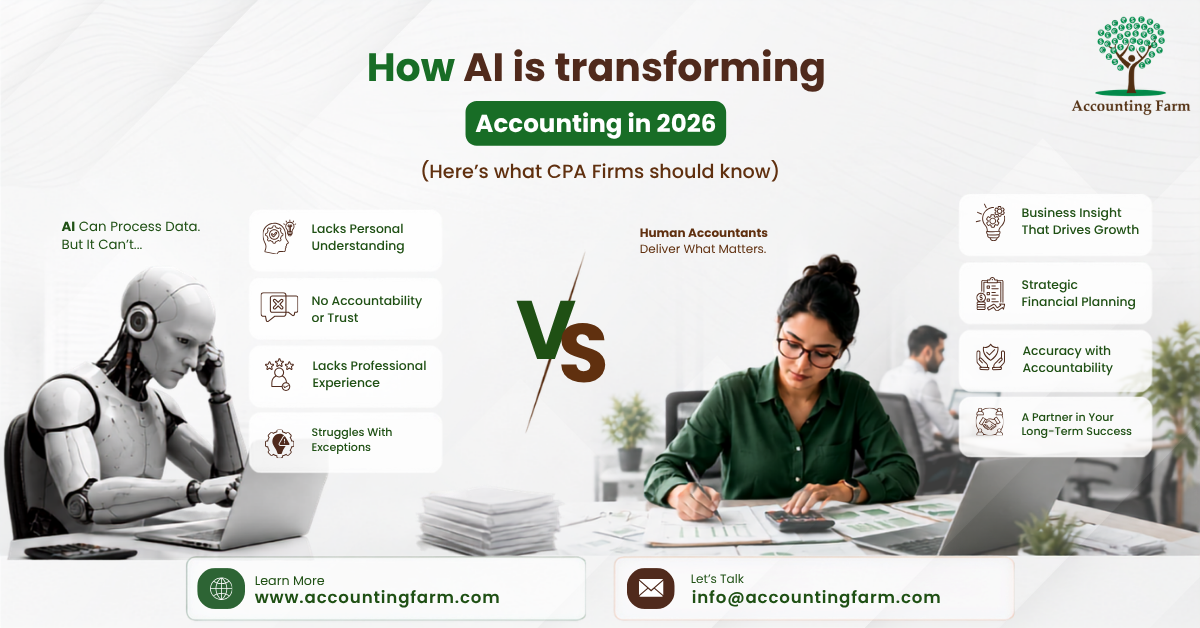
Accounting has never been a static profession it’s always bent around whatever tools showed up next, from ledgers to spreadsheets to cloud software. But what’s happening right now with AI feels different. It’s not a slow adoption curve anymore. By 2026, AI sits inside the daily workflow of one-person practices and massive CPA firms alike, and honestly, most people barely notice it’s there. It’s just how the reports get made now.
There’s a rumor that won’t die: that AI is going to put accountants out of work. It’s wrong, and anyone who’s actually used these tools day-to-day knows why. AI is good at grinding through repetitive tasks. It’s not good at judgment, and judgment is most of what accountants get paid for.
So let’s get into what’s actually changed, what firms are gaining from it, where things can go sideways, and why pairing AI with real, experienced people still beats going all-in on either one alone.
Why This Matters Right Now
Think about how much data flows through a single firm in one week. Invoices piling up, accounts that need reconciling, payroll runs, reports due Friday, tax documents that can’t wait. All of that used to swallow hours that could’ve gone somewhere better financial planning, business advisory, tax strategy, actually talking to clients instead of typing numbers into a spreadsheet.
That’s the shift AI is making possible. Less time on data entry. More time on the stuff that actually moves the needle for clients.
What AI Is Actually Doing in Accounting Right Now
Bookkeeping is probably where most firms start. Transactions get categorized, bank statements reconciled, records kept tidy, and it happens without someone manually keying in every line which also means fewer of the small inconsistencies that creep in when a person’s doing it by hand at 5pm.
Invoice processing has quietly gotten a lot less painful too. Instead of someone retyping vendor details line by line, platforms scan the invoice, pull the numbers out, and log the transaction on their own.
Reporting is faster now what used to take most of an afternoon can happen in a few minutes and there’s a decent argument that AI catches strange spending patterns better than a person can, especially on the fifth review pass of a long week.
Fraud detection is another area where the speed difference is night and day. Machine learning models can scan thousands of transactions for anomalies in a fraction of the time a manual review would take.
And payroll salaries, deductions, tax withholding, compliance rules gets calculated automatically, which cuts down on the kind of small errors that turn into big headaches later.
What This Means for CPA Firms
The gains firms report tend to cluster around a few themes. Work that used to take hours gets done in minutes. Records stay cleaner because automation doesn’t get tired or distracted the way people do by the end of a shift. Clients get faster turnaround on reports and reconciliations, which matters more now than it used to since expectations have shifted toward “instant.” Costs drop because less manual labor is going into routine work. And because AI can surface patterns in the data that a person might miss, the advice firms give clients tends to get sharper too.
Will AI Replace Accountants?
No and it’s worth explaining why instead of just saying it. AI is excellent at processing data and spotting patterns in it. What it can’t do is read a client’s actual situation, weigh competing priorities, or build the kind of trust that keeps someone with the same firm for a decade. That’s not a technology gap that closes with a better model next year. It’s just a different kind of work.
The firms getting real value out of AI treat it like a very capable assistant, not a replacement for the people at the table. Clients still need someone for tax planning, financial advice, audit support, business consulting, regulatory compliance, and the strategic thinking that a dashboard simply can’t produce on its own.
Where Firms Need to Be Careful
None of this comes without friction, and it’s worth being upfront about where things can go wrong.
Financial data is sensitive by nature, so the platform matters security and regulatory compliance should carry more weight in that decision than whichever tool has the flashiest marketing. Training matters just as much; handing a team new software and assuming they’ll figure it out on their own is a common way firms waste money on tools nobody ends up using well. There’s usually an upfront cost too, though most firms recoup it fairly quickly through efficiency gains. And no matter how good the automation gets, someone still needs to be the final check on anything that actually matters AI can recommend, but a person should be the one signing off on critical financial decisions.
Does Outsourcing Still Make Sense With AI Around?
Some firms assume that once AI is doing the heavy lifting, outsourcing becomes redundant. In practice it’s closer to the opposite the two work well together rather than compete.
A strong outsourcing partner brings skilled people and the technology stack together in one package, which usually beats either one running solo. That’s the model we work from at Accounting Farm modern accounting tools paired with the kind of expertise you only get from people who’ve been doing this for years. It’s how firms end up cutting costs, speeding up turnaround, and scaling without the quality slipping along the way.
A Few Practical Recommendations
If a firm is weighing whether to bring AI into its workflow, a reasonable starting point looks something like this: begin with bookkeeping automation since it’s the easiest win and the lowest risk. Choose cloud-based software with real security behind it, not just whatever’s cheapest this quarter. Keep training the team on an ongoing basis rather than treating it as a one-time onboarding task. Keep a human reviewing AI-generated reports, at least for now, since the technology still gets things wrong occasionally. Bring in an experienced outsourcing partner for anything specialized. And push the team’s time toward advisory work instead of routine processing wherever possible.
Where This Is Headed
AI is nowhere near done reshaping this industry. But the firms that end up ahead won’t be the ones that just bolted new software onto old processes they’ll be the ones that figured out how to combine that technology with people clients genuinely trust.
Clients want a trusted advisor at the end of the day, not just a well-oiled automation pipeline. Firms that adopt new tools without losing that relationship are the ones holding the advantage a few years from now.
This was never really humans against AI. It’s humans getting better at the job because AI took the parts nobody wanted to do in the first place.
Bottom Line
AI has changed accounting by absorbing the repetitive work, tightening accuracy, and freeing up time that used to disappear into data entry. But the technology by itself isn’t the whole story. The firms pulling ahead are the ones pairing smart automation with people who bring insight, strategy, and the kind of personal judgment no algorithm replicates.
If your firm is trying to run leaner, cut costs, and grow without stretching the team thin, working with an experienced outsourcing partner like Accounting Farm gets you the benefit of modern accounting technology without losing the human judgment clients actually rely on.
Frequently Asked Questions
Find answers to common questions about accounting outsourcing, bookkeeping, taxation, payroll management, and how Accounting Farm helps businesses streamline their financial operations.
No. It handles repetitive work well, but tax planning, consulting, and client advisory still need an experienced person behind them.
Better productivity, fewer manual errors, faster reporting, lower operating costs, and sharper financial insights.
Yes. Plenty of cloud-based platforms now offer AI features priced for firms of any size, not just the big players.
AI speeds things up; outsourcing brings the experienced people who keep everything accurate, compliant, and strategically sound.